

Poetry Books

Over Here plunges us into the middle of things. The book’s elegiac sweep, as Alan Gillis extends the tonal depth and lyric resonance of his work, is combined with dark humour, imaginative flights, rants, raves, and daring provocations. Dramatic and ruminative, the poems explore the threshold between inner and outer worlds, alert and inquisitive about what we lose and what abides. Spanning past and present, parenthood and childhood, what is here and what is gone, set-pieces and shorter lyrics range widely, yet keep returning to what is at the core of experience. Some poems are set in Ireland, some in Edinburgh. Many take a walk (sometimes a drive) through town or countryside, building up a head of steam, trying to come to terms with the state of oneself and the state of the world. But at all times life’s beauty and bruises are registered through a love of language, verve and commitment, mixing hurt with hope, empathy with oomph. (Book cover blurb)
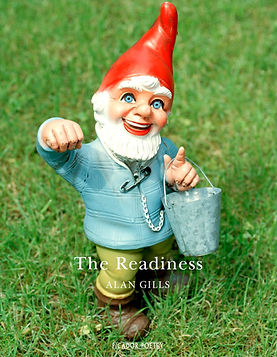
‘Fizzing with vernacular and bounding rhythms, yet also precisely lyrical, the poems in The Readiness frequently run away with themselves, attempting to keep up with, and make some sense of, the often digital babble and information overload of our age. … But rather than simply glare at the world through a screen or situated perspective, Gillis is able to reflect both our private and public selves back at us, in poems that are as capacious and various as the come-and-go places they situate themselves. … The Readiness impresses, but more importantly moves and surprises, given Gillis’s ability to combine dry humour with insight, vibrant description with direct address, and contemporary relevance with lasting concerns. (Ben Wilkinson, Poetry Review)
‘Part of the strength of Gillis’ work to date which this book has in spades is that his is not an unserious art, but at the same time seems utterly incapable of the sage old over-arching ‘project’ that so many collections these days lose their shine to while trying to keep The Main Point in the air above the poet. While there is both the profound and the weighty in The Readiness, Gillis does not squat Atlas-like before the reader, demanding our appreciation of his effort in the bearing of great weight. … this is a collection that rewards rereading and reevaluation. It’s a proper book of poems’ (Patrick Davidson Roberts, The High Window)

‘Scapegoat includes more of Gillis’s characteristically rumbling love poems and wildly inventive pastorals. It is also much concerned about thinking through how poems can compete with and supplement our increasingly visual, online culture. … [His] ability to take a hammer to polite pieties does not involve sacrificing the ability to write affectingly about how we live now.’ (John McAuliffe, The Irish Times)
‘The collection opens with a condemning epigraph: “The harvest is past, the summer is ended, and we are not saved,” Jeremiah, 8:20. Well, that might be alright if the result is as rich, frenetic, visually and audibly pleasurable a landscape as Gillis provides. Scapegoat lyrically and variously interrogates memories of youth through a blend of Irish dialect and imaginative narratives. Gillis’s skillful modulation of tone and his aphoristic precision allow him to create moments that ring true to feeling and afterthought, articulating the complex emotional resonance of memory.’ (Maya Popa, Poetry)
‘Throughout the collection ... we see Gillis continuing in the poetic tradition critical of the industrialized world which began with figures such as Blake, Wordsworth and Clare, who witnessed the displacement of the agrarian world as people were sucked into the cities for reasons of economic necessity. Of course there are other contemporary poets who plough this furrow, but Scapegoat stands out as a substantial and powerful critique of all that's disastrous about our era.’ (Rachael Boast, The Irish Review)

‘Gillis gives contemporary poetry a much-needed shot in the arm; poetic language is vivified, made stimulating and vital, in poems that leave the reader hanging on for dear life over every expertly-executed turn. … leaving his influences for dust as he strikes out for his own territory. ‘WOW, here it comes’, the song from which the collection gets its name bursts open, and the force of this poetry is as unstoppable and gripping as that of the dark night itself’. (Maria Johnston, Poetry Ireland Review).
Here Comes the Night extends Gillis's range both stylistically and thematically, establishing him as one of the finest poets of his generation, in Ireland and the UK. Having moved to Edinburgh from Belfast, he has encountered a different landscape and social texture, and this is also reflected in the book. This is merelyone further index of the expansion of his poetic world; indeed, it is difficult to imagine what his style will not be able to deal with in the years ahead. (Justin Quinn, The Irish Review)
In this wonderful collection, Gillis’s audacious formal and linguistic virtuosity immerses the reader in a twofold world separated by an invisible screen, a two-way looking glass, through which the poet constantly navigates. (Alexandra Tauvey, Tower Poetry).

‘Although he now lives and works in Scotland, Gillis has written a volume which puts into poetry a new Belfast – one which is partly ‘the new Belfast’ of contemporary perception – in such a way as to change the literary map. … Gillis’s book is more than a series of accomplished performances; the volume has a coherence and a depth which many older poets would (or should) envy. Those old chestnuts, the public and the private, are put at odds in original ways in Gillis’s poetry; and here it is the completely convincing grasp of the particular, in time and place, which grounds his complex and dark intimations of the world’s troubles, and the self’s helplessness in the face of these.’ (Peter McDonald, Tower Poetry).
‘These poems stage a verbal crash of pop culture, the globalised capitalism it serves, and the defiantly and problematically local embodied in nonce words and dialect. … Typically his double sestina features dreams of Emmanuelle Béart, while the rhyming couplets of ‘Bob the Builder is a Dickhead’ cite as their anti-hero the Fat Controller from Thomas the Tank Engine. Since these poems can crack a joke, they risk being underestimated. While the hurly-burly of Gillis’s compound adjectives, lists of synonyms and endless puns can seem best appreciated in individual set pieces, the references between poems across the collection demonstrate a more complex plot. … Hawks and Doves shows that process of literary fusion to be developing into a uniquely contemporary talent’ (Selina Guinness, The Irish Times).

‘How often have you been excited by a new poem? Excited enough, that is, to pick up the phone and tell people about what you’ve just discovered? Like me, perhaps, you would answer well, no, not all that often. We all find different poems exciting for different reasons, of course; and the last two poems that had this particular effect on me were in the same book by the same author: in Alan Gillis’s debut collection Somebody, Somewhere.’(Peter McDonald, Tower Poetry Review).
‘Gillis’s voice is as distinctive as it is welcome in contemporary Irish poetry and Somebody, Somewhere must rank as one of the best first collections to be published in quite some time. … Gillis veers effortlessly between an almost baroque gorgeousness of diction and a pithy rattle of end-stopped lines. In Gillis’s writing, Nature and Culture are not engaged in a predictable aesthetic standoff, but the natural world continually tips over into the world of the virtual and the material. The verbal clustering of a Joyce and a Hopkins kpps company with the random detonations of Marvel Comics’ (Michael Cronin, Poetry Ireland Review).
‘Shite? No. ... He is urban and brash but there are moments reached after his deft displays when a reader must gasp or be silent, much as you might after watching a dancer do something impossible with gentle grace’ (Malachi O’Doherty, Fortnight).